
Alejandro had a staple between his teeth when Martin asked whether anyone had considered putting the pages in order. He removed it carefully and set it beside the stapler, where it would remain for considerably longer than anyone had anticipated.
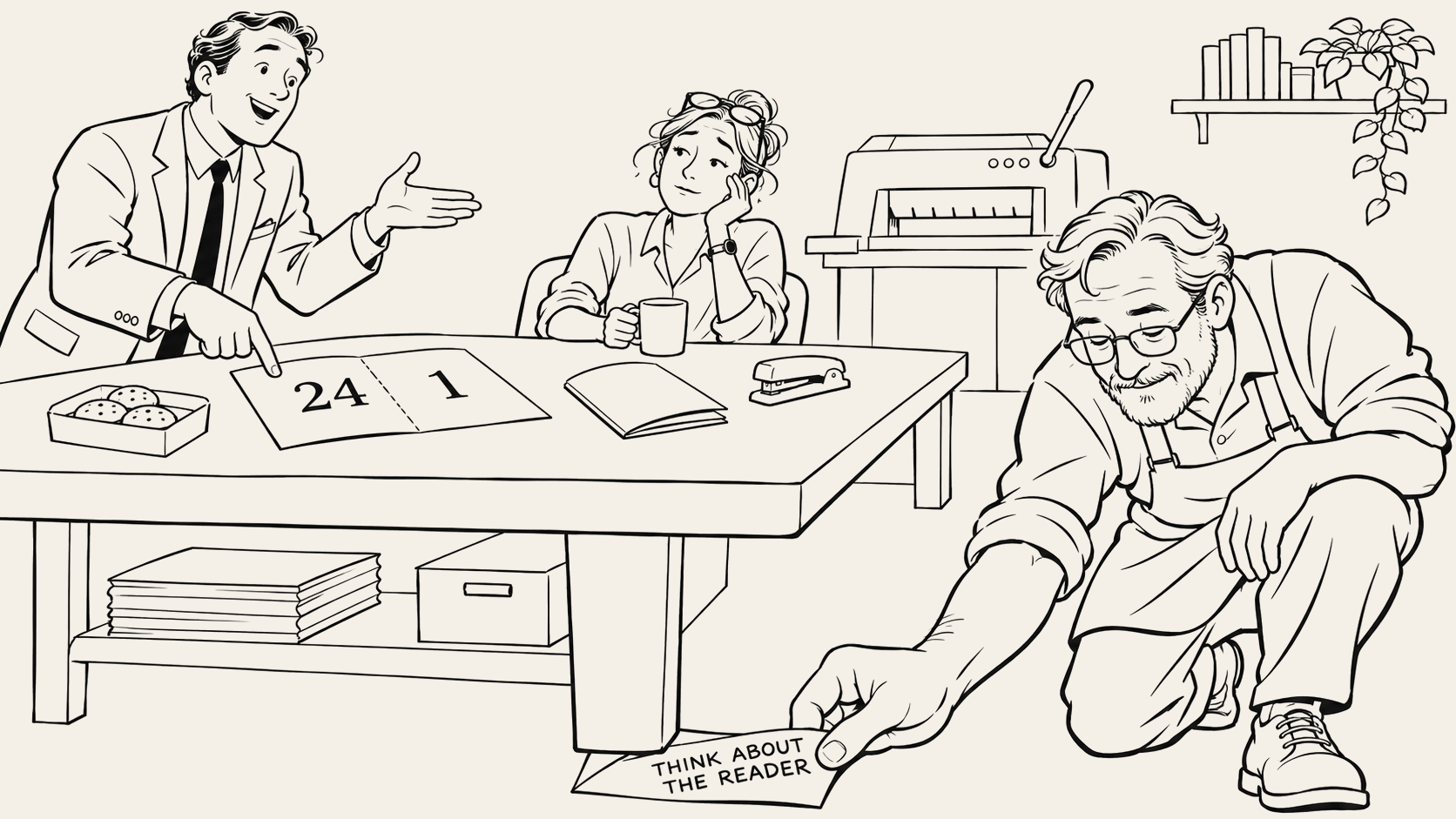
On the table lay the printed sheets for a twenty-four-page programme. Page twenty-four sat beside page one. On the reverse, page two sat beside page twenty-three. Alejandro had been arranging pages this way for thirty-one years, during which several million people had successfully reached the middle of a booklet. He was about to fold the first sheet when Martin placed a finger on the twenty-four.
“I'm going to stop us there.”
Iris took her hand off the stapler. Across the room, Nina slowly lowered the lid of her yoghurt. It was 9:40, and the meeting had been scheduled for ten minutes. Its purpose was to confirm whether the words “Welcome Drinks” should become “Welcome Reception” before a hundred programmes went to print for the Borough Business Excellence Awards, an event at which local companies congratulated one another beneath a sponsored balloon arch. The answer was yes. Iris had made the change at 9:38.
At Bell & Finch, this would ordinarily have concluded the intellectual portion of the morning. Alejandro would make a folded proof, somebody would check it, and the machine would begin producing small, respectable objects that could be exchanged for money. Nina had already arranged the van. Iris had a restaurant menu waiting on her screen, its owner having discovered overnight that the establishment was Mediterranean. The rest of the day was lined up behind these programmes, ready to move as soon as they did.
“The reader,” Martin said, placing a finger on page one, “starts here.” He paused. It was a generous pause. Everyone had time to find the page. “Then they want page two.”
Martin had joined the company six months earlier to look after client accounts. Until Saturday, his contributions to design had largely involved forwarding emails with the words “Thoughts?” attached. On Saturday, however, he had completed an introductory workshop called Design That Works, during which he had made a poster for an imaginary jazz evening.
The poster featured a trumpet, a date, and ample negative space. Martin had moved the date twice. The instructor had said, “There you go,” and Martin had been going ever since. He had learned about alignment, contrast, and visual hierarchy, each of which had produced an immediate improvement when applied to his trumpet. The exercise had gone smoothly. The imaginary musicians had raised no objections. Nobody had paid extra to have a larger name. When he finished, the whole evening fitted comfortably on a single page.
On Monday he had brought the poster into the office. Iris had said it looked good. Alejandro had nodded. Nina had asked whether the jazz evening was real, which Martin had taken as evidence of effective communication. She had been hoping to go out on Friday.
Now he drew his finger from page one to page twenty-four, inviting the room to contemplate the distance. Alejandro began to explain what happened when the paper was folded, but Martin was already smiling and spreading his hands, making room for production somewhere in the future.
“Absolutely. We'll come to the production side. But let's get the fundamentals right first.”
He pulled up a chair and leaned on the table. It rocked slightly. Alejandro steadied it with his knee while Nina put the yoghurt in her drawer. “You have to guide the eye,” Martin explained. “Give people a clear path. They won't work hard to understand your layout.” He delivered this facing Iris, who had designed the company's stationery, three exhibition catalogues, and a book on minimalist architecture so restrained that a customer had once returned it believing several pages were missing.
At the next table, Toby looked up. Toby was seventeen, had been an apprentice for eleven weeks, and was still under the impression that questions were requests for information. When Martin asked what message they were sending by putting twenty-four beside one, Toby began to answer. Nina immediately sent him to check whether the van was still coming at twelve. He had checked six minutes earlier, but she thanked him with such warmth that he went to check again.
Martin watched him leave with approval. It was good to involve the younger people. That was how they learned. Meanwhile, Alejandro picked up the first sheet and brought its edges together. Martin gently held one corner against the table and asked whether he could finish his thought. Alejandro laid it flat again. His knee remained under the short leg.
Iris turned to her monitor and opened the view that displayed the programme in reading order. It began with the cover and ended with a full-page advertisement for a firm that described itself as “Your Partner in Getting Things Done.” The firm had supplied its advertisement nine days late. Between these two achievements, the pages proceeded in the sequence Martin had recently recommended.
“There. Already much clearer,” he said. “Sometimes all it takes is a fresh pair of eyes.”
Iris had been about to explain the two views, but Martin was already taking a biscuit. She left her hand on the mouse and watched him inspect the screen. He gave the small, satisfied nod people give when a child finally manages a difficult shoe.
Martin always brought good biscuits. Proper ones, in a tray, with chocolate substantial enough to leave fingerprints. When Nina's car had broken down in February, he had driven her home for three evenings and refused petrol money. He remembered birthdays. Once, after a client had kept Iris waiting until seven, he had stayed to help her carry exhibition boards to the car in the rain. Nina slid the packet towards Alejandro. Alejandro took one without looking at her.
“While we're here,” Martin said, and Nina stopped sliding the packet.
The programme's opening spread had caught his attention. The left page contained the mayor's welcome, a photograph of the mayor, the mayor's signature, and a short biography of the mayor, who had apparently felt that the photograph and signature left too much to chance. The right page contained the evening's schedule. Martin stood behind Iris's chair and formed a rectangle with his thumbs and forefingers. She waited for him to finish framing the monitor she had bought and calibrated.
He wanted to discuss breathing room. “Space isn't wasted space. That's the thing people struggle with at first. You don't have to fill every inch.” Iris opened the folder containing the earlier drafts. The first had been spacious. The second had accommodated the photograph. By the fifth, the mayor had acquired a childhood, two honorary appointments, and a wife with a charitable foundation. Martin suggested they avoid getting bogged down in versions.
He put his hand over the bottom third of the biography. “See? Instantly calmer.”
“That covers his work with disadvantaged children,” Nina said.
He moved his hand up.
“That's his wife.”
He removed his hand. For a moment, the mayor remained intact.
Iris offered to get the council on the phone. She knew the assistant who would answer, the pause that would follow, and the eventual request to send everything again as a Word document. Martin glanced at the clock. “At this stage? I think we need to be pragmatic.” They could revisit the broader approach next year. Iris closed the folder. It still contained last year's version of this discussion, in an email Martin himself had forwarded.
Toby returned with confirmation that the van was still coming at twelve. Martin welcomed the news. They were making progress. Nina opened her drawer, looked at the yoghurt, and closed it again.
At 10:06, Alejandro stood up to retrieve the stapler. Martin stood too, apparently under the impression that they had reached the practical portion of his workshop. He collected the loose sheets and began laying them out in what he described as an intuitive sequence. One would lead to two, then three, then four. He checked that everyone agreed with this before proceeding. Nobody challenged the proposed direction of counting.
The paper proved less cooperative. Martin laid down the first sheet with page one on the right, turned the second over, then turned it back. A third contained pages five, six, nineteen, and twenty, all of which seemed to have made private arrangements. He spread them farther apart. This improved the spacing but left the numbers substantially where they had been. After a little more rearranging, he asked Alejandro for a clean set.
Alejandro said that it was a complete set.
“Clean as in sequential, Alejandro.”
There was a soft crack. Everyone looked at the biscuit in Alejandro's hand. Iris offered to print twenty-four separate pages in reading order, and Martin accepted with visible relief. That would have been a useful starting point. As she turned to her keyboard, Nina suggested fresh coffee. Nobody needed coffee. Four people immediately wanted some.
In the kitchen, Toby put five mugs on the counter and proposed bringing out last year's programme. They could unfold it. Martin would see where the pages went, and then they could finish. He explained the idea twice, encouraged by the absence of objections. Iris watched the kettle. Alejandro stirred an empty mug. Nina took the spoon gently out of his hand and laid it on the counter.
Toby looked from one to the other. His suggestion appeared to have been received quite favourably, although nobody had moved towards the shelf. From the workroom, Martin called that there was no rush; he was just making a few notes. Alejandro looked towards the door. The kettle clicked off into a silence that everyone allowed it to keep. Nina made his coffee and gave him back the spoon.
They returned to find yellow sticky notes attached to several pages. One said CONSISTENCY. Another said THINK ABOUT THE READER. A third occupied most of the space Martin had previously identified as needing to remain empty. He had arranged them carefully and uncapped a second pen. Iris put the reading copy beside him, clipped at the top-left corner. Toby had fetched last year's programme after all, but a small shake of Iris's head sent it quietly back to the shelf.
Martin leafed through his new copy with growing satisfaction. On page eight, he asked why one heading was larger than another. Iris explained that the smaller one belonged to a category within the section. He tapped it twice. “That's what we were talking about earlier. Good.” She took a drink of coffee. It was too hot. She continued drinking it.
The sponsor pages offered another opportunity. Martin brought up the jazz poster on his phone and showed Alejandro how the date aligned with the trumpet. Alejandro put on his glasses, examined it, and took them off again. In the programme, the gold sponsors were larger than the silver sponsors, who were larger than the community supporters. This hierarchy had been purchased, at considerable expense, by people who measured it with rulers. Nina explained the packages when Martin suggested making everything the same size. He accepted the commercial realities, provided they were making a conscious decision. She assured him that they were.
At 10:37, Nina's phone rang. She left the room with the speed of a woman whose long-lost family had finally located her. The driver was doing their collection first now. Eleven-thirty. She repeated the time on returning, placing it carefully between Martin and the next page.
Alejandro gathered the six original sheets before anyone could discuss it. He folded them, nested them, and put two staples through the spine. It took less than a minute. Toby watched with the solemn attention usually given to a man disarming something. Alejandro opened the booklet at the cover and turned the pages slowly. Two. Three. Four. Five. Everything arrived where it had been expected, as it had been doing in similar booklets for some time.
“Ah. You've reordered it.”
“It's the set we started with,” Alejandro said.
Martin took the booklet, turned it over, opened it at the back, and returned to the front. He pressed the centre flat to inspect the staples. Nobody helped. Toby stood very still beside a wastepaper bin, holding a piece of scrap he had apparently forgotten how to throw away.
“Right,” Martin said eventually. “So this is a printing convention. That wasn't clear from the way it was presented.”
Iris moved a loose sheet out from beneath his elbow and set it beside the booklet. “It looks different flat.”
Martin considered the two objects, then nodded. “That's useful context. Next time, lead with that.” Alejandro rubbed his thumb over the staple and said he would try.
Martin settled back with the programme across his knees. Once assembled, he observed, it followed precisely the principle he had been explaining. One, two, three. The underlying point still stood. He turned the pages again, allowing them all to see it standing.
The printer beeped from the next room. Alejandro turned towards it with an expression Nina had previously seen only when his granddaughter arrived unexpectedly. He had nearly reached the door when Martin suggested that somebody ought to check the booklet properly. “Sometimes when you've been doing something for a long time, you start working on autopilot. Fresh eyes.” Alejandro came back and sat down beneath the production checklist he had written and revised over fourteen years.
Nina took a clean sheet of paper, wrote 11:30 on it, and laid it beside the programme.
“Martin, could you check the client names against the approved list? That would be a huge help.”
He accepted the list and pencil with the mild reluctance of an architect being asked to carry a brick. His interest had been in the overall approach, but Iris assured him that he had given them plenty to work with. For four minutes, everyone worked. She checked the corrected line against the email. Alejandro checked the print settings. Nina confirmed the collection details. Toby took the mugs to the kitchen one at a time, making the journey last.
The silence ended at Whitcomb. Martin knew a Whitcombe and wondered whether the accountancy firm might require the same final letter. Nina confirmed that it did not. He compared the name on the approved list with the name in the programme, then consulted the list again. Both continued to say Whitcomb. He ticked it with the pencil. Worth checking. Under the table, Alejandro's foot had begun to tap; Iris nudged his shoe with hers, and it stopped.
At 10:56, the proof was approved. It contained exactly one change from the version on the table at 9:40: a small pencil tick beside Whitcomb. Alejandro went through to the print room, and within moments the machine began its steady, reassuring work. Nina called the driver. Toby began constructing a cardboard box with a concentration he had previously reserved for operating the cutter.
Martin stayed beside Iris's desk. It had been a productive session, he felt. Sometimes people needed to step back to see what was obvious. She saved the file. “I might put together a short session for the team,” he said. “Nothing intimidating. Just a few principles.” Through the glass partition, Alejandro caught Nina's eye; Nina looked down at her phone. Iris saved the file again and suggested checking the schedule.
Martin understood. Everyone was busy. He stacked his loose reading copy and tapped the edges square, then looked at the neat booklet beside it. Could he have one like that? It would be easier to carry. Iris handed it over. He turned a few pages, nodded, and tucked it beneath his arm.
“See? Much better when we keep it simple.”
At eleven-thirty, the boxes left in the van. Nina retrieved her yoghurt. Iris returned to the menu of the newly Mediterranean restaurant. In the print room, Alejandro swept the offcuts into the bin while Toby collected the sticky notes from the table. He paused over the one that said THINK ABOUT THE READER, then held it up for Alejandro to see.
Alejandro took it, folded it into a small square, pressed the creases flat with his thumbnail, and slid it beneath the short leg of the table.